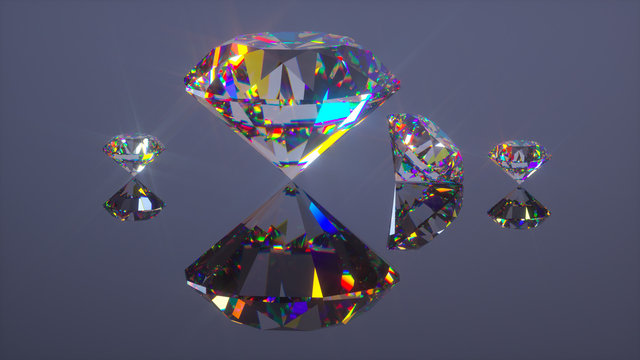
There is something intrinsically special about a diamond – its meaning, its worth – the fact that it is crafted in the crust of the Earth. Buy a diamond, and you are not just buying a beautiful, sparkling stone – you are buying a unique piece of history – a moment in time – never to be repeated.
The same cannot be said of lab diamonds, which, as their name suggests, are engineered in
the laboratory. Despite gaining some popularity in recent years, here’s why, in our humble opinion, synthetic diamonds aren’t on par with the real thing.
Natural History
First of all, natural diamonds are geological wonders. Formed billions – yes, billions of years ago, diamonds require several fortuitous events to come to fruition. Their creation, 100 miles below the Earth’s surface, depends on intense pressure (about 50,000 times that of the surface of the Earth) and temperature (around 1600°C) for carbon atoms to bond with one another, crystalise and form diamonds.
And that’s not all.
In order to reach the Earth’s surface, diamonds rely upon deep-source volcanic eruptions, which mostly took place between 20 and 30 million years ago. This happened as magma flowed through deep fractures in the Earth, creating carrot-shaped rock formations known as ‘kimberlite pipes,’ which carried the gems from the Earth’s mantle to the crust.
These hidden, vertical structures can take decades to be uncovered. Only around one percent of known kimberlite pipes are economically viable, underscoring the value of diamonds as one of the Earth’s most precious natural resources.
V.s Technology
Lab-grown diamonds, meanwhile, are entirely man-made. And you would be wrong if you thought they were an exclusively Gen Zen/Millennial thing. The very first lab diamond was created back in 1954.
Lab diamonds are made by technology that mimics the natural diamond-growing process, with scientists today employing one of two methods. HPHT (high pressure, high temperature) is the original technique. In this instance, a tiny diamond seed is placed in a capsule with a mixture of metals and carbon, then heated and pressurised. Depending on the desired specifications, the process may take a few months, and HPHT diamonds tend to be more colourless than their synthetic counterpart.
Meanwhile, CVD (chemical vapour deposition) involves filling a chamber with several gasses, including carbon, hydrogen, and oxygen, before adding a diamond seed or graphite. Using microwaves, lasers, or a hot filament, the chamber is then heated to temperatures of 800º to 900º C. Carbon gases ionise and, eventually, particles stick to the original diamond and cause crystallisation. CVD is a speedier process than HPHT and only takes a few weeks. This practice also makes it easier to produce diamonds in larger sizes and quantities.
A Bubble Already Burst?
Lab diamonds may have the same optical, physical, and chemical properties as an equivalent natural diamond, but do they carry the same value? No. Not even close.
Typically, a lab diamond, with identical carat weight and grade, will cost around 60 to 85 per cent less than a natural diamond. While this may appear attractive at first glance – that you can get the same or a more sizeable diamond for less – it is also reflected in the value of this lab-grown product.
In 2023, the global diamond market, which is largely unregulated, was valued at $26 billion and is expected to reach $50 million by 2030 – almost half the value of the current natural diamond sector.
However, some industry insiders are already warning the lab diamond boom is well and truly over, with forecasts prices will continue to fall. Over the past year, lab-grown diamonds have dropped by 30 per cent in price and have been declining year on year. Cost reductions in technology and manufacturing and greater competition mean market prices are falling. As this continues, those who have purchased lab-grown diamonds will see a significant amount of their value wiped.
Resale
Indeed, lab diamonds lose much of their worth as soon as you step out of the store. Some experts estimate that synthetic diamonds can drop to as little as 10 per cent of their original price. Natural diamonds, meanwhile, retain value and continue to have a buoyant resale market. Aiding this is the industry’s continued growth. In 2023, the natural diamond market was valued at $94.19 billion, and this figure is expected to increase to $97.57 billion in 2024 and further to $138.66 billion in 2032.
Smoke and Mirrors
Besides cost, one of the main selling points of lab diamonds is their apparent eco-friendliness when compared with naturally sourced gems. However, in reality, they are far less sustainable than what they are being marketed. Over 60 per cent of lab diamonds are made in India and China, and their creation consumes vast quantities of fossil fuels.
When mining for natural diamonds via open-pit, underground, or marine mining, there’s no escaping the fact that it can and does compromise the surrounding environment and ecosystems. On average, mining companies move 250 tons of earth per carat of mined diamond, which consumes a great deal of energy, usually powered by fossil fuels.
However, many companies are working towards improving their diamond mining techniques and minimising their ecological footprint. Ethics and sustainability play a more significant role in diamond extraction than ever. Water recycling is becoming standard practice, and many mining companies are committing to restoring mined land to its original state or improving it and making it economically viable once it exits. Part of today’s natural diamond sustainability is ensuring the local economy benefits from mining by creating jobs, investing in community development, and paying fair royalties.
Diamonds Are Indeed Forever
Natural diamonds remain the most popular and sought-after gem worldwide due to their beauty and rarity. Considered a timeless investment and a symbol of luxury, the sparkle of a natural diamond will always outshine a man-made replica.