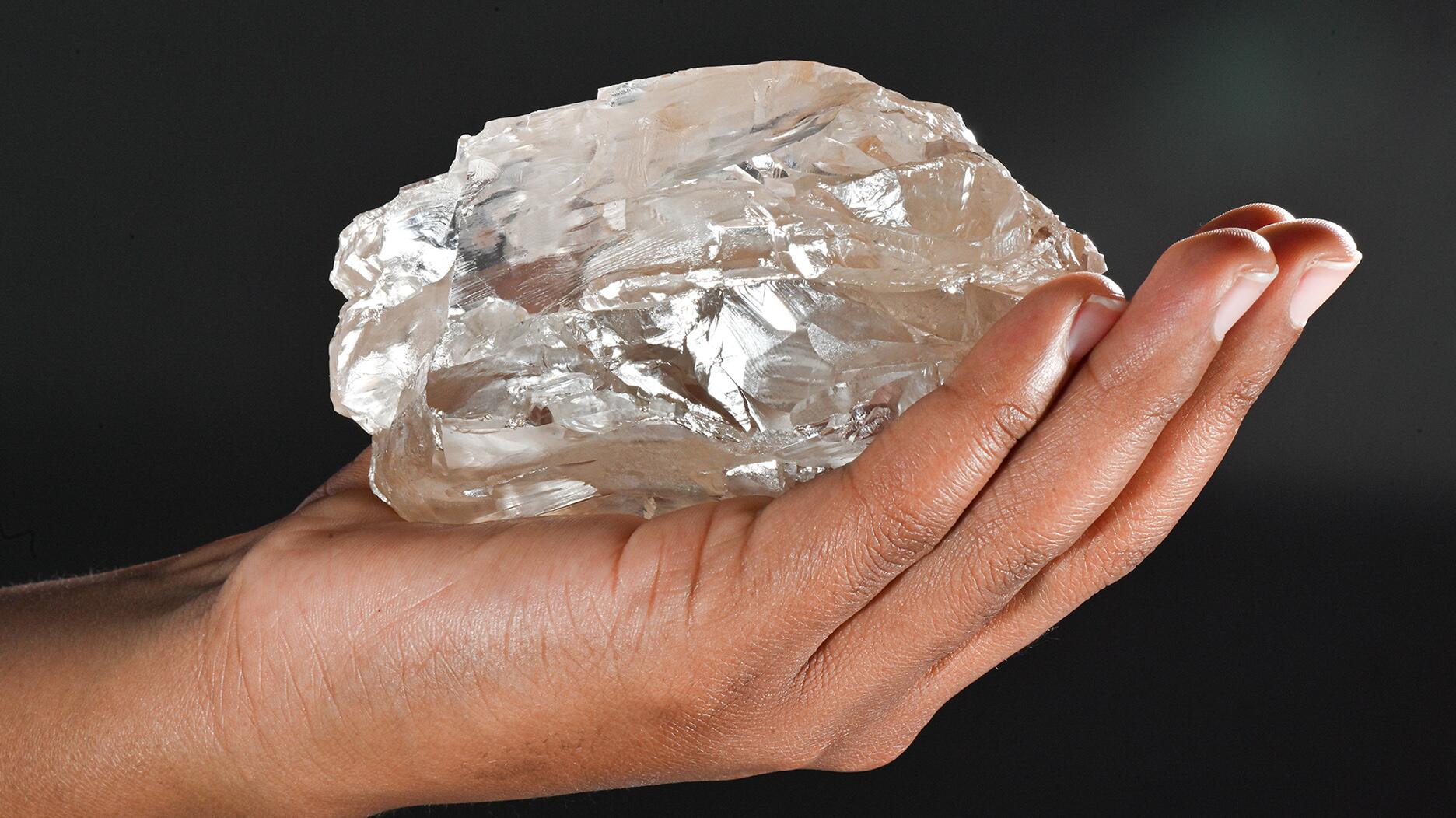
Imagine being handed the largest diamond that Africa has unearthed in over a century. For Botswanan President Mokgweetsi Masis, this was a reality, when the colossal 2,492-carat uncut gem was presented to him and the world during a filmed viewing ceremony.
“Whaatt?!” was the shocked reaction of the president, as his cupped hands were suddenly weighted down with the sparkling, (almost) half-a-kilogram uncut gem. “It is overwhelming. I am lucky to have seen it in my time.”
Indeed, the yet-to-be-named diamond is the largest to be found in the world since 1905.
While no decisions have been made on how it will be sold, nor its value, a smaller diamond from the same mine was sold for a record-breaking $63 million in 2016.
Small Mine, Big Diamonds
Using X-ray technology, August’s hefty diamond was extracted from the Karowe mine, owned by Canada’s Lucara Diamond Corp, located about 300 miles north of Botswana’s capital, Gaborone.
The relatively small mine is famed for its exceptionally large diamonds and counts the 1,758-carat Sewelô diamond among its most lucrative finds. Sold to French fashion house Louis Vuitton in 2019 for an undisclosed amount, the Sewelô bore the world’s second-biggest diamond title – until now.
Two years earlier, the 1,111-carat Lesedi La Rona diamond was dug out from the same mine and bought by a British jeweller for $53 million.
With this latest record-busting find, Karowe Mine boasts five diamonds over 1,000 carats to its name in the last decade.
The King of Diamonds
Despite the mine’s extraordinary success, the Cullinan diamond is yet to be dethroned from the top spot.
Uncovered at the Premier Mine in Transvaal, South Africa, 119 years ago, the Cullinan continues to hold the record as the largest diamond ever found.
The massive 3,106-carat colourless diamond, which spanned 10.1 x 6.35 x 5.9cm, was named after Sir Thomas Cullinan – the man who discovered the mine three years earlier.
In 1907, the Transvaal government gifted the enormous diamond to the reigning British monarch, King Edward VII. It took three men working 14-hour days for eight months to cut and polish nine large stones and 97 smaller ones, several of which form part of the famous British Crown Jewels.
No Longer the World’s Top Value Producer
As well as making global headlines, Botswana’s latest diamond find may help the country shore up its position in the market for 2024.
Until a few months ago, the African nation was ranked first among the world’s top diamond-producing countries. However, with 2023’s output now disclosed, Russia has, for the first time, surpassed Botswana as the leader in rough-diamond production value.
And here’s the why: In 2023, Russia produced 37.3 million carats of rough diamonds valued at $3.61 billion. This represents an average price of $97 per carat, marking a sizeable increase from the previous year’s output of 41.9 million carats, valued at $3.55 billion and averaging at $85 per carat.
Meanwhile, Botswana’s diamond production value dipped in a change of fortunes. The country produced 25.1 million carats in 2023. This was valued at $3.28 billion, with an average price of $131 per carat. The previous year, Botswana’s output was 24.5 million carats, valued at $4.7 billion, with an average price of $192 per carat.
The decline, however, may be short-lived as the reduction in value is partly attributed to the lower output mix from De Beers’ Jwaneng mine as it undergoes expansion.
A Force Still to Be Reckoned With
Regardless of the drop in value, the African country’s diamonds remain world-sought after. They are generally larger than those mined in Russia and of better quality.
Botswana is home to several top-tier mines. Among these are the world’s leading diamond mines, Orapa and Jwaneng, with the latter clocking up an average of 10 million carats per annum.
That’s a lot of potential engagement rings.
Botswana’s Big Diamond Business
Indeed, some of the world’s highest-yielding mines were discovered in Botswana by the mid-1980s, with diamond exploration underway in the 1950s and mining officially beginning in 1971.
The land-locked country of just 2.5 million people, which makes it one of the most sparsely populated countries in the world, saw Botswana dramatically increase its GDP by joining the diamond trade.
Today, the country’s economy relies heavily on its diamonds, which account for around 80 per cent of exports, one-third of fiscal revenues, and one-quarter of GDP.
Africa’s Diamond Hotbed
So, when it comes to extracting the biggest and best diamonds, why is Africa seeing the most success?
Much of the continent of Africa sits on a tectonic plate. Billions of years ago, diamonds formed deep inside the earth’s mantle, where high temperatures and pressure cause carbon to crystallise into a diamond structure. Diamond creation requires specific conditions. Depths of 100 miles below ground are needed for pressure to hit 725,000 pounds per square inch and temperatures to reach a blistering 2500 degrees Fahrenheit. On top of this, underground volcanic eruptions over 20 to 30 million years ago drove diamonds closer to the surface where they are mined today.
Although many large diamonds probably once existed, a significant amount were likely broken up over the years by heavy-handed mining practices before the necessary technology was implemented.
As this year’s discovery indicates, there is potential for finding more substantial-sized diamonds in the future, and the world is eagerly anticipating new records being set.